

The First Discord Election
What happens when a generation raised on anime, Discord, and TikTok gets politically awakened? In Nepal, they didn’t just protest. They reprogrammed power with memes, mobile games, and One Piece.

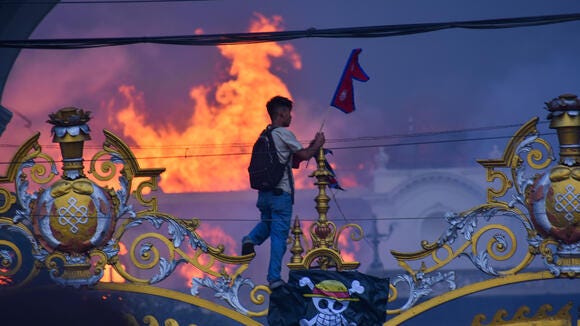
A teenager stands on the ornate, golden gates of a government building in Kathmandu, holding the flag of Nepal high. Draped over the gate beneath him is another banner.
It’s not a national flag.
It’s a cartoon skull with a straw hat—the symbol of the Straw Hat Pirates from the anime One Piece.
Behind him, the building is engulfed in fire.
This is the moment a protest became a declaration of war.
Shoot Down That Flag
In the world of One Piece, there’s a moment that breaks through the screen/page.
The setting is Enies Lobby, the judicial island of the World Government. Nico Robin, a woman hunted by this global regime since she was a child, finally breaks. Cornered and hopeless, she screams the words her pursuers never wanted to hear:
“I want to live!”
It’s the first time she has ever asked for help. And Monkey D. Luffy, her captain, doesn’t hesitate. He turns to face the flag of the World Government, the symbol of absolute, unquestionable authority. He points. He gives the order.
“Sogeking... shoot down that flag.”
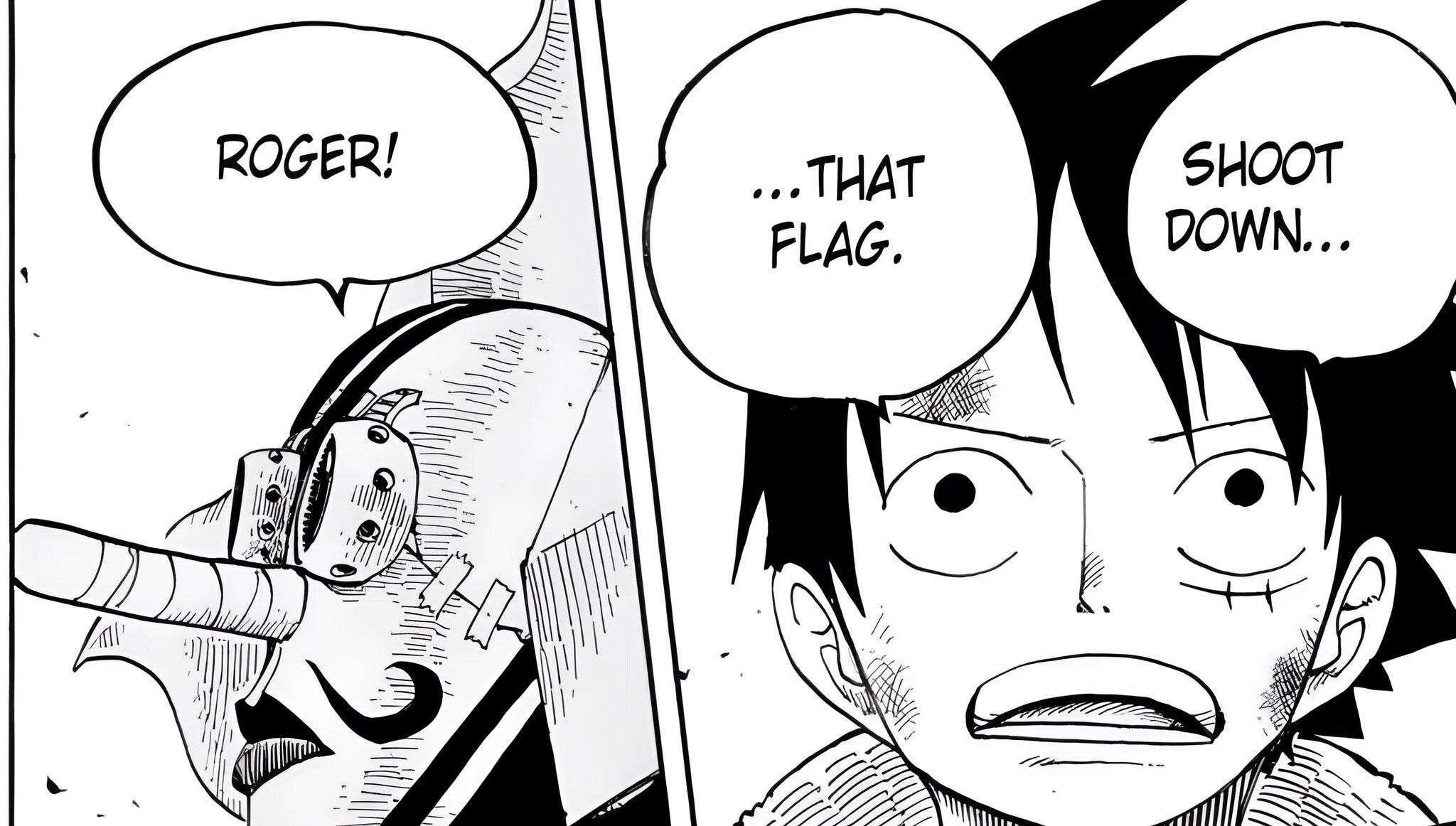
The crew doesn’t flinch. A single, flaming shot flies across the sky. The flag ignites, a declaration of total war against the most powerful institution on the planet.
For a generation raised online, this was more than a scene. It was a moral blueprint. If you grew up in a world that felt broken, watching institutions fail and seeing corruption go unpunished, you felt the logic of that moment in your bones. It wasn’t about pirates. It was about choosing your people, your nakama, over any system that tries to break them.
That is why, two decades later, teenagers in Nepal marched into the streets waving that same skull-and-crossbones.
Not as a joke. Not as a meme.
As a statement.
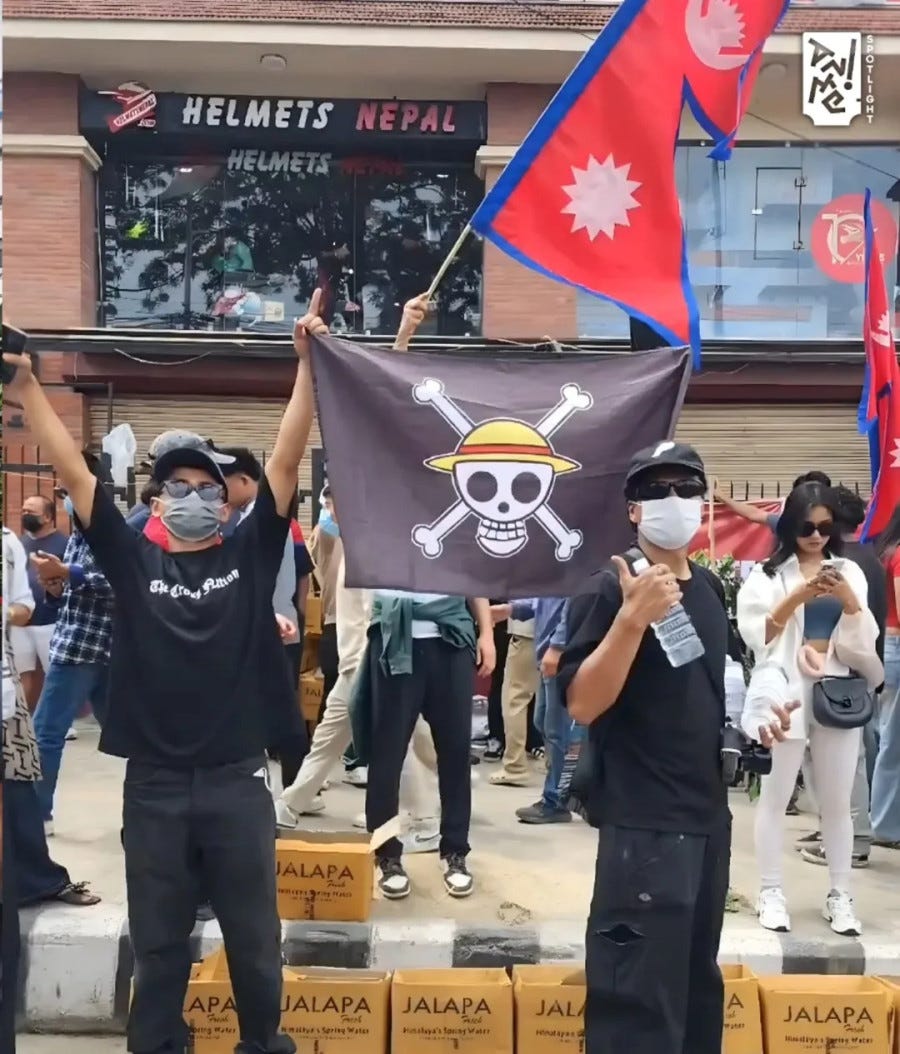
In One Piece, the “World Government” is the dominant political regime: a corrupt, elitist institution that upholds control through censorship, fear, and force. In Nepal, the kids weren’t making a reference. They were drawing a parallel.
The Straw Hat Jolly Roger became more than merch. It became a globally understood symbol of liberation, appearing at protests from France to the Philippines.


Because in the story, that flag means something very specific:
You protect your friends, no matter the cost.
You challenge corrupt authority without permission.
You refuse to be tamed.
When the tear gas hit, the flags stayed up. Kids in school uniforms held signs with the Straw Hat logo. The hashtag was simple: #WakeUpNepal. They weren’t using the slogans of a political party. They were using the iconography of a pirate crew.
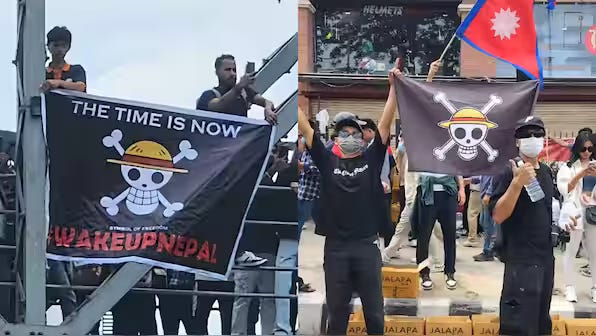
Because in One Piece, crews don’t need permission to form. They find each other through loyalty, not legality.
They have a word for it: nakama.
It’s a Japanese term. It translates to friend, comrade, crew. But the real meaning is deeper. It is a promise. It means you are one of us. It means we don’t leave you behind.
And in the streets of Kathmandu, surrounded by rubber bullets and water cannons, the nakama had shown up.
Nepal Was A Powder Keg💣
The protestors had a name for their revolution: Jana Andolan 2082.
In Nepali, it means “The People’s Movement of 2025.” The name was a deliberate choice. “Jana Andolan” is the historic title of Nepal’s past democratic uprisings. By claiming it, Gen Z wasn’t just starting a riot. They were tapping into a deep well of national pride. This is a country that was never colonized, that famously fought off the British Empire to a standstill. They were declaring themselves the next chapter in a long, generational war for the soul of their country.
This new chapter, however, didn’t start with a political speech. It started with a meme.
The gap between the ruling class and the youth wasn’t just visible. It was broadcast. In the months leading up to the protests, Nepali TikTok was flooded with clips of politicians’ kids flaunting their wealth.
“Nepal has a nepo baby problem.”


That line stuck. Because it was true.
The government’s response was a classic authoritarian miscalculation: they tried to ban the major social media platforms. It was a fatal error. For a digital-native generation, deplatforming isn’t a punishment. It’s a migration.
They simply moved to where fewer eyes were watching. TikTok became a digital underground. Discord turned from a gamer chat app into a resistance HQ.
From that chaos, a new language of protest was born. It was a language of defiant absurdity. Tourists ran through the streets like characters in Subway Surfers.
They played UNO in circles on the pavement while the march surged around them.
They mashed up anime clips with footage from the streets, narrating their own revolution in real time.
And most strikingly, they danced.
Clips showed young Nepalis performing choreographed dances in front of burning barricades and riot police. It was a culture war fought with emojis, edits, and a complete refusal to play by the old rules.
It wasn’t just political. It was cinematic.
And it had gone viral.
The Battle for Kathmandu
The government’s social media ban was the final mistake. It was an attempt to silence a generation whose entire existence was defined by having a voice online. For them, the internet wasn’t just a tool; it was territory. And the government had just tried to invade it.
The digital dam broke. The flood hit the streets.
It began on September 9th. Thousands of students, still in their school uniforms, marched through Kathmandu. The initial calls were for transparency and an end to corruption.
The government met their calls with tear gas, water cannons, and rubber bullets. The brutal crackdown only fueled the fire.
The protest was no longer a march. It was a riot.
For two days, the capital became a warzone. The footage that escaped the media blackout was raw and unfiltered, broadcast not by news cameras, but by the phones of the protestors themselves. Government buildings were set ablaze.
One image became a defining receipt of the human cost: a young protestor, shot and bleeding in the street, being tended to by his friends.


This was the moment the nakama bond was tested with real blood.
By September 11th, the capital was paralyzed. The government was in chaos. In a stunning admission of defeat, they began evacuating key officials from rooftops by helicopter.
The old guard was running.
Their physical infrastructure had failed. Their control over information had shattered. Their authority was gone. The government of Nepal, for all practical purposes, had ceased to exist.
And into that power vacuum stepped a Discord server
.A Government Forged in Chat
It was a scenario without precedent. The official government had collapsed, but the nation’s digital parliament, the “Youths Against Corruption” server, was more active than ever. With the streets still smoldering, they faced a critical question: what now?
They did what their generation was built to do. They held a poll.


It wasn’t a joke. It was a radical experiment in direct democracy, conducted in the only functioning town square left. The server moderators, now a de facto election commission, put forth a list of respected, non-establishment figures. The question was simple: “Who now?”
Thousands of users voted. The results were clear. The winner, with 50% of the vote, was Sushila Karki, the first female Chief Justice of Nepal, a figure with a reputation for integrity and a history of battling corruption


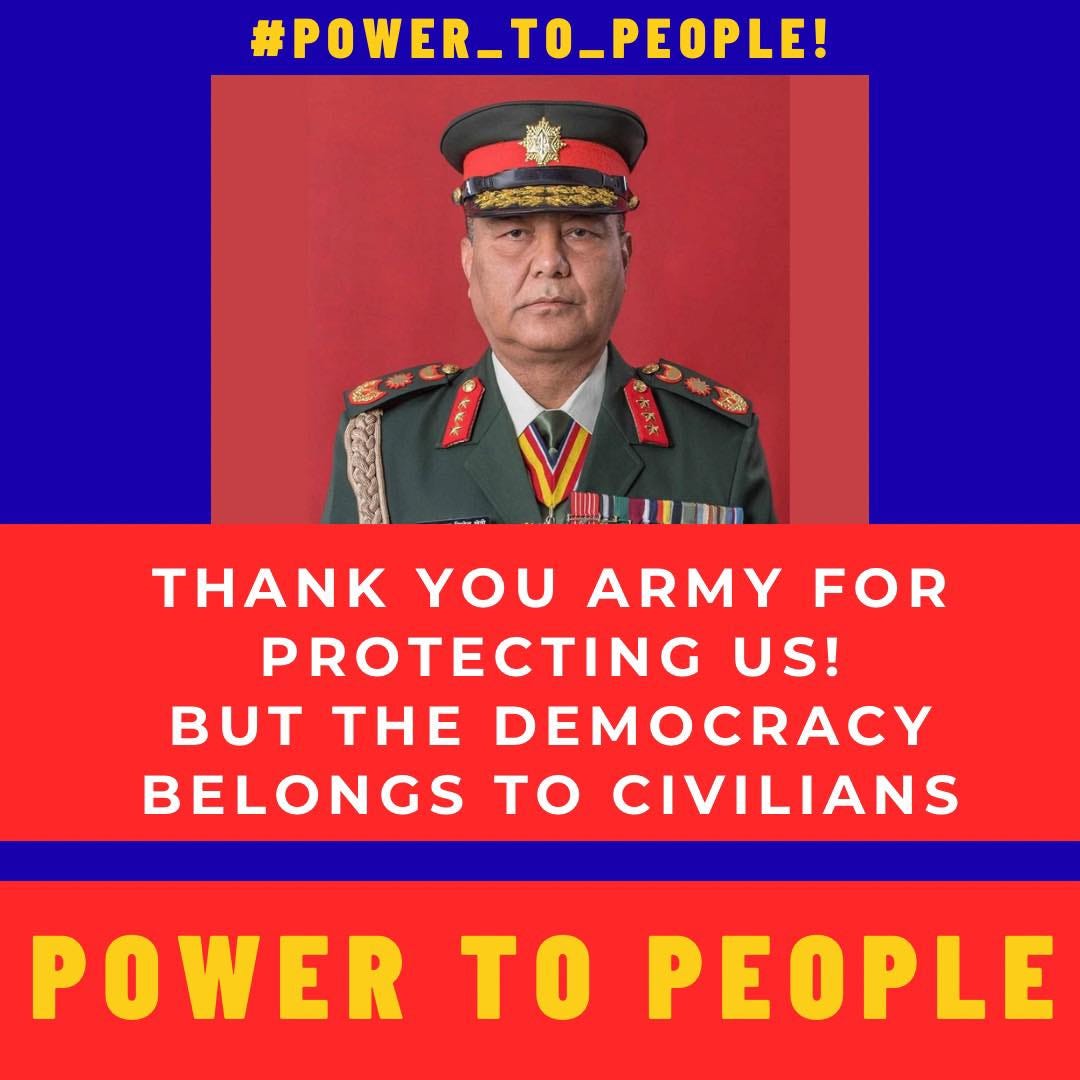
A Discord poll, however, has no legal authority. The final piece of the puzzle was the military. The protestors had brilliantly framed the army not as an enemy, but as the protectors of the people. Now, they presented them with a choice: prop up the corpse of a collapsed, corrupt government, or honor the clear, digitally-certified mandate of the people.
The army chose the people.
On September 14, 2025, in a move that stunned the world, Sushila Karki was sworn in as the head of a new interim government, escorted by the very same soldiers who had been fighting protestors just days earlier.
A revolution that began with a generation’s rage against a corrupt system found its voice in the language of a pirate anime, and ended with the formation of a new government. A government forged in a chat room.
This was the story of the Jana Andolan 2082 - The Gen-Z revolution in Nepal- and the first ever Discord election A story that started not with a political speech, but with a meme.
It was the story of a generation that was told they had no future, so they built one in a chat room. A generation that saw their country’s history of defiance and decided to write the next chapter.
They were dismissed as kids playing games, but they turned a Discord server into a parliament. They were mocked for using a cartoon flag, but they turned a symbol of fiction into a banner of real-world liberation.
When the state tried to silence them, they met tear gas with dance-offs and riot shields with games of UNO. When their friends fell, they held vigils and fought harder.
They proved that a revolution in the 21st century isn’t just fought in the streets; it’s coded, edited, and memed into existence. This was the story of a culture war that ended in a political coup. A war that Gen Z didn’t start, but was determined to finish.
“The kids who have never known peace and the kids who have never known war... they have different values. Whoever wins this war becomes justice.”
- Donquixote Doflamingo
“The one piece is real!”
Amazing stuff and terrifically put together for someone who doesn't know much about the situation
I had no idea of the situation on Nepal. This article was detailed, organized and professionally explained! Love it!